Cybersecurity
Phone Scams Targeting Frederick Medical Office Staff Win With Politeness, Not Malware
November 24, 2026 · 8 minutes
Verizon's 2026 data shows the human element played a role in 54% of healthcare breaches.
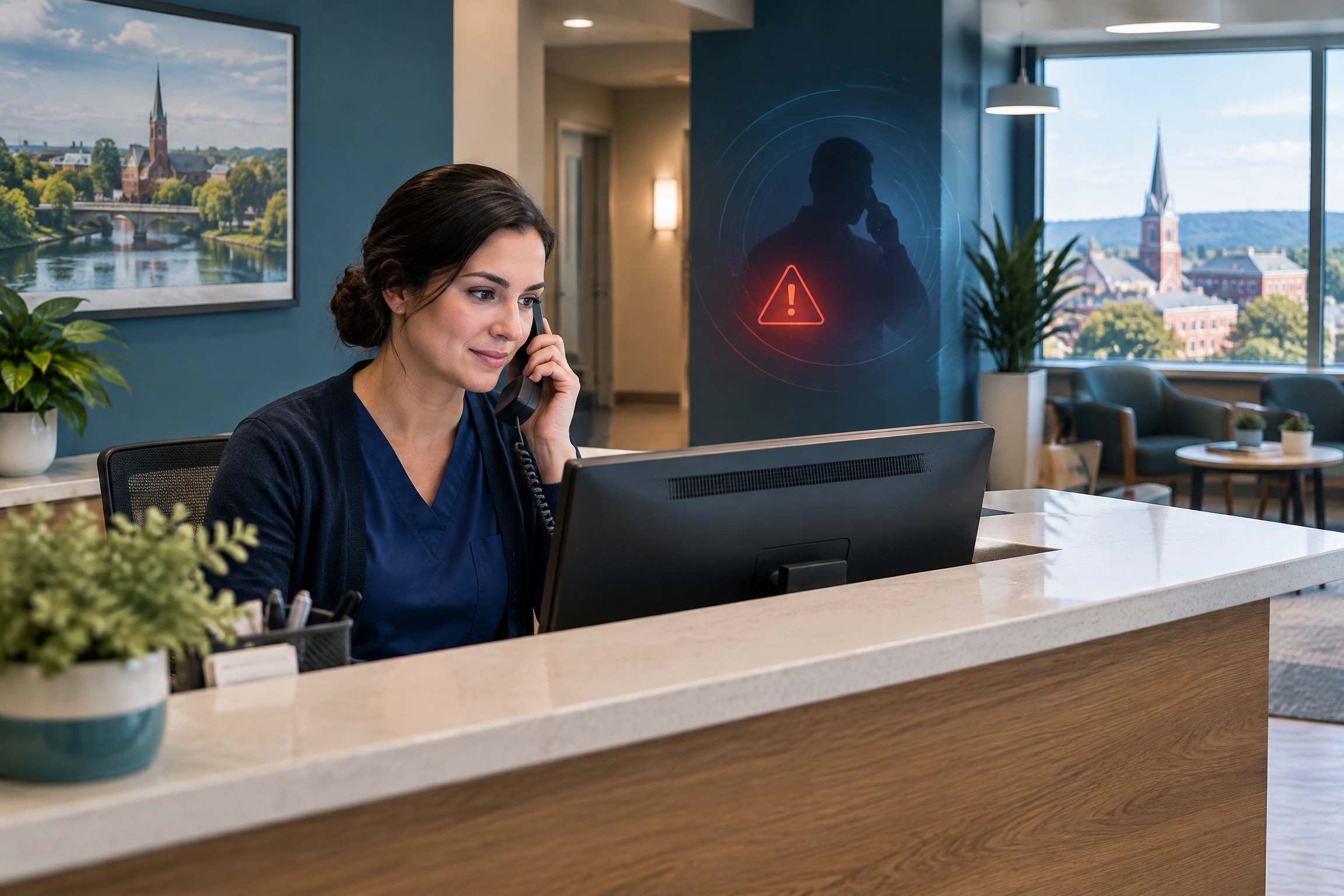
Phone scams targeting Frederick medical office staff exploit that gap with nothing more than a friendly voice and a believable story.
No malicious link arrives, and no antivirus alert fires. The caller simply asks the right person for the right thing at the right moment. For a busy front desk juggling check-ins, insurance questions, and a ringing line, that moment comes dozens of times a day.
Why the Front Desk Gets the Call
Front desk teams are hired and trained to help. They schedule visits, confirm coverage, release records, and smooth over problems so patients leave happy. Those same instincts make them the most valuable target in the building for someone with bad intentions.
The front desk also sits close to systems that matter. Scheduling platforms, patient portals, billing tools, and email accounts are often one login away. A caller who talks their way past one person can reach data that took years to collect.
Smaller practices feel this pressure most. A family medicine office, dental practice, or physical therapy clinic may have two or three people covering every phone line. Nobody has time for a long investigation in the middle of a full waiting room, and scammers know it.
Verizon's 2026 Healthcare Snapshot puts the broader risk in clear terms:
- System Intrusion, Miscellaneous Errors and Social Engineering represent 81% of healthcare breaches.
- Personal data was compromised in 37% of healthcare breaches.
- Credentials were compromised in 25% of healthcare breaches.
- Financial motives drove 99% of healthcare breaches.
Across all industries, the same research found that pretexting appeared in 6% of breaches.
Pretexting is the formal name for inventing a believable scenario to get information. In phishing simulations, median click rates for mobile-centric vectors also ran 40% higher than email, which means people tend to let their guard down away from the inbox.
The Calls That Sound Completely Routine
The most effective scam calls do not sound like scams at all. They borrow the tone, vocabulary, and urgency of the calls a practice handles every week. That familiarity is the whole strategy.
The Helpful IT Technician
A caller says they work for the practice's IT provider or software vendor. They mention an update, a security issue, or a problem with the practice management system. Then they ask the employee to read back a code, visit a website, or install a remote support tool.
Once that tool is running, the caller has the same access as the person sitting at the keyboard. Multifactor codes read aloud over the phone hand over the final lock on an account. Many practices only learn what happened when strange logins or missing files appear days later.
The Patient Who Is Not the Patient
Another common script involves someone posing as a patient, a family member, or a caregiver. They sound stressed, they know the patient's name and birthday, and they need results or records quickly. Those personal details are often easy to find online or in earlier breaches.
The goal might be medical information, insurance details, or a change to the contact information on file. A changed email address or phone number can let the caller reset portal passwords later. One cooperative phone call quietly sets up a much larger problem.
The Insurer, Pharmacy, or Vendor Confirming Details
Some callers claim to represent a health plan, a pharmacy, a billing company, or a lab. They say they only need to "confirm" a member ID, a tax ID, or banking details before processing something. Because the practice deals with these organizations constantly, the request feels normal. Among all phone scams targeting Frederick medical office staff, this one may blend in best.
These calls are dangerous precisely because confirmation feels harmless. Repeating a number the caller seems to know already does not feel like disclosure. In practice, it often fills in the one detail the caller was missing.
The Physician Who Needs It Done Now
A newer twist involves a caller posing as one of the practice's own providers or managers. They claim to be stuck at the hospital, at a conference, or on the road with a dead laptop. They need a password reset, a schedule change, or a payment sent before the end of the day.
Employees rarely want to tell a doctor to wait, especially when the request sounds urgent. Scammers count on that hesitation and often call when the genuine provider is known to be away. A few public details from a website or social media profile make the story surprisingly convincing.
What One Successful Call Can Set in Motion
For most scammers, the call itself is rarely the end goal. Access gained over the phone often becomes the starting point for email takeover, fraudulent payments, or a larger intrusion. The employee may never connect the later problem to that one friendly conversation.
The consequences reach well beyond the IT closet. Patient trust takes a hit when records are exposed, and a small practice depends heavily on word of mouth. Staff time disappears into password resets, patient notifications, and conversations with insurers or regulators.
Daily operations can suffer too. If a caller gains remote access, systems may need to be taken offline while they are checked and cleaned. For a practice running a full schedule, even a few hours without scheduling or charting creates a backlog that lasts for days.
Warning Signs Worth Practicing on Every Shift
These calls tend to follow recognizable patterns. Teams that know these signals can slow a call down without being rude to legitimate callers.
- The caller pushes urgency, deadlines, or consequences for delay.
- They ask the employee to skip a normal step "just this once."
- They resist a callback or offer their own number to call instead.
- They request passwords, multifactor codes, or remote access.
- They know some details and ask the employee to confirm the rest.
- The call lands during the morning rush or right before closing.
None of these signs proves a call is fraudulent. Together, they are a reason to pause, verify, and involve a manager before sharing anything.
What HIPAA Expects Before Information Changes Hands
The HIPAA Privacy Rule already sets the standard. Before permitted disclosures, a covered entity must verify the identity of a person requesting protected health information when that identity or authority is not already known. That requirement applies whether the request arrives in person, in writing, or over the phone.
For phone scams targeting Frederick medical office staff, that rule is the first line of defense. Verification is not extra caution or optional courtesy. It is part of the job for every practice handling patient information.
A clear phone verification process helps a practice show it takes that duty seriously. Written procedures also give new hires something concrete to follow from their first day.
Verification does not have to feel cold or bureaucratic. A friendly script such as "I'll call you right back at the number we have on file" protects the patient without sounding suspicious. Most legitimate callers understand, and many appreciate the extra care with their information.
Building a Verification Habit That Holds Under Pressure
Lasting protection depends more on routine than on willpower. Good intentions fade during a packed afternoon, so the process has to be simple enough to follow automatically. Practices across Frederick, from downtown offices to clinics in Urbana and Walkersville, can adopt a few habits that work with almost any phone system.
- Call back using a number already on file, never one the caller provides.
- Treat every request for a password or multifactor code as suspicious.
- Confirm IT requests through a known contact or support ticket first.
- Verify patients with at least two identifiers before discussing records.
- Give every employee a clear person to escalate unusual calls to.
- Log suspicious calls so patterns become visible over time.
Short practice drills help these steps stick. A five-minute review of a recent suspicious call at a team meeting teaches more than a long annual training session. Employees also need permission to end a call politely when something feels wrong.
Leadership sets the tone here. When managers and physicians follow the same verification steps, nobody feels singled out for asking questions. A provider who thanks an employee for double-checking a request reinforces the habit better than any policy document.
Technology That Backs Up the People
Training carries most of the load, but technology can shrink the damage when someone gets fooled. The goal is to make sure one phone call cannot unlock everything at once.
- Multifactor authentication that uses push approvals or number matching limits code-sharing tricks.
- Restricting who can install remote access tools keeps a caller from taking control.
- Endpoint detection and response can flag unusual activity after a successful scam call.
- Role-based access means a front desk login only reaches what the front desk needs.
- Alerts for changed patient contact details help catch account takeover attempts early.
Each layer assumes that someone, someday, will be fooled by a convincing caller. That assumption is not pessimism; it is simply good planning.
These controls work best when someone reviews them regularly. Settings drift, new employees join, and software updates can quietly change defaults. A periodic look at accounts, permissions, and remote access tools keeps the safety net intact.
Courtesy and Caution Can Share the Same Desk
Patients in Frederick deserve a front desk that is warm, responsive, and easy to reach. Those qualities are why patients choose a practice and keep coming back, and none of them has to change. What changes is the expectation that every unusual request gets verified, no matter how kind or urgent the caller sounds.
Phone scams targeting Frederick medical office staff succeed when helpfulness has no guardrails. A simple callback rule, a firm stance on codes and passwords, and supporting security controls turn that same helpfulness into a strength. The practices that build these habits now protect patients, protect their teams, and keep a friendly voice from becoming the weakest point in the office.
Sources
- Verizon, 2026 Data Breach Investigations Report, Healthcare Snapshot: https://www.verizon.com/business/resources/reports/2026-dbir-healthcare-snapshot.pdf
- U.S. Electronic Code of Federal Regulations, 45 CFR 164.514(h), Verification Requirements: https://www.ecfr.gov/current/title-45/subtitle-A/subchapter-C/part-164/subpart-E/section-164.514